What to do after a relapse: the next 24 hours, and the plan after
What to do after a relapse: stay safe, stop the slip from growing, learn what triggered it and build a relapse prevention plan. Without the shame spiral.
Also in: العربيةDeutschEspañolFrançaisहिन्दीBahasa IndonesiaItaliano日本語한국어नेपालीPortuguês

You used again. Maybe once, maybe for a few days. The voice in your head is probably saying one of two things: "I've ruined everything" or "Well, I've blown it now, so I might as well keep going." Both are the slip talking. Neither is true.
Relapse is part of many recoveries. The US National Institute on Drug Abuse (NIDA) puts relapse rates for substance use disorders at 40 to 60 percent, in the same range as high blood pressure and asthma, and says a relapse means treatment needs to be resumed, changed or tried another way. It does not mean the effort failed.
The first 24 hours
- NowStop and get safePut distance between you and the substance or the app. Get to a safe place. If you are in danger, call for help.
- Within the hourTell one personA friend, your sponsor, a helpline, your doctor. Secrecy is what turns a slip into a relapse.
- TonightBe kind, eat, sleepNo big decisions and no punishment. Hydrate, eat something, rest.
- Tomorrow morningRestart the clockA new start time. The days you already had still count.
- TomorrowFind the triggerWhat happened in the hours before? Write it down while it is fresh.
- This weekChange one thingOne concrete change to your plan, aimed at that trigger.
Lapse or relapse?
A lapse (or slip) is a single episode of use. A relapse is a return to the old pattern. The difference is often decided by what you do in the hours after the lapse.
Psychologists Alan Marlatt and Judith Gordon described the "abstinence violation effect": after a lapse, people who see it as proof of personal failure ("I have no willpower, I'll never change") are more likely to go on using than people who see it as a specific, fixable event ("I drank because I went to that party tired and alone, with no plan"). How you explain the slip to yourself often decides what happens next.
| Shame thought | Useful thought |
|---|---|
| I've ruined everything | I had a slip on one day. The other days happened |
| I have no willpower | I had no plan for that situation |
| I might as well keep going | The next hour is a new choice |
| Everyone will be disappointed | The people who matter would rather know |
| I'm back to day zero | My count restarts. My experience does not |
Find the trigger
Go back through the 24 hours before the slip. Usually it was not one moment but a chain.
- Where were you, who with, what time?
- How were you feeling? Hungry, angry, lonely, tired, stressed, bored, celebrating?
- What was the first small decision? Taking a route past the shop, opening the betting app "just to look", staying at the party after 11.
- What did you tell yourself? "Just one." "I deserve it." "Nobody will know."
- What would have helped at step 3? That is where your new plan goes.
Build a relapse prevention plan
Relapse prevention, developed from Marlatt's work, is one of the best-studied approaches in addiction treatment. Its core is simple: know your high-risk situations, have a coping plan for each, and treat lapses as information. Put yours on one page:
| Part of the plan | Example |
|---|---|
| My top 3 high-risk situations | Friday after work; arguments with my partner; being home alone late |
| Early warning signs | Skipping meals, sleeping badly, isolating, romanticising the old days |
| If-then plans | If it is Friday at 6 pm, then I go to the gym and text Sam on the way |
| People I will call | Sam, my sister, a helpline |
| What I do in a craving | 15-minute delay, slow breathing, read my reasons |
| What I do if I slip | Stop, tell Sam within the hour, restart, review the trigger the next day |
| Reasons I am doing this | In my own words |
The techniques for the craving moment are in how to stop cravings.
How SoberChamp handles a slip
We designed Rise Again around this research. Logging a slip opens a short, kind flow in three steps.
- What happened: Pick what fits (stress, a party, feeling low, loneliness, celebrating, tiredness, an argument) with no essays needed.
- What you learned and what you need now: Talk to Sori, make a plan for next time, or rest.
- Rise again: A new start time, and a clear list of everything you keep: total sober days, best run, rank, sunstones and your Haven.
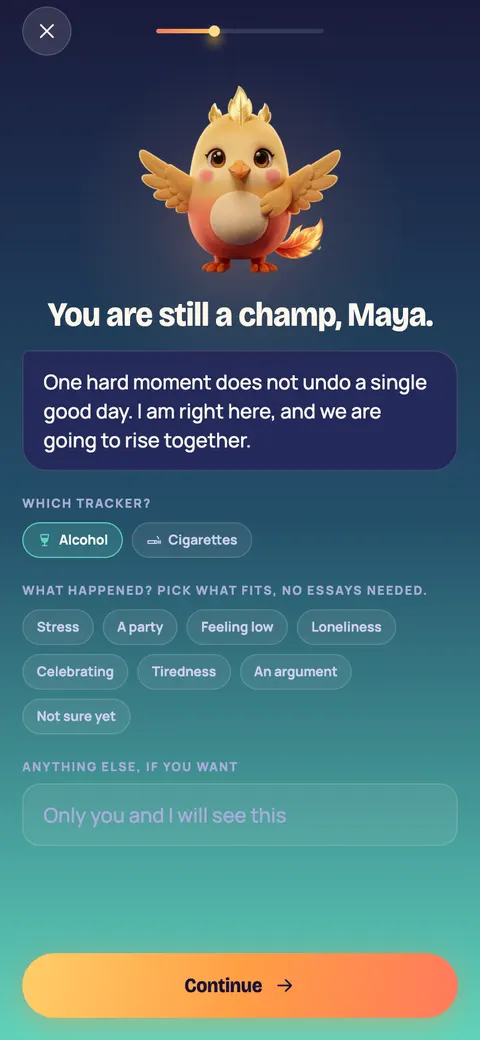
Sori responds with care, never disappointment, and the calendar marks the day as a "rise again day", not a failure.
When to get more help
Talk to a doctor or treatment service if slips are getting more frequent, if you are using more than before, if you have physical withdrawal, or if you feel hopeless. In the US, the SAMHSA National Helpline (1-800-662-4357) is free, confidential and open 24 hours. If you are thinking about ending your life, call or text 988 in the US or Canada, or Samaritans on 116 123 in the UK and Ireland.
FAQ
What should I do right after a relapse?
Get safe, stop using, and tell one person within the hour. Then rest, eat and avoid big decisions. Tomorrow, restart your count and write down what led to the slip.
Does a relapse mean I failed?
No. NIDA compares relapse in addiction to relapse in other chronic conditions such as hypertension and asthma, with similar rates. It means the plan needs adjusting.
What is the difference between a lapse and a relapse?
A lapse is a single use after a period of abstinence. A relapse is a return to the previous pattern. Acting quickly after a lapse makes a relapse less likely.
Do I have to start my sober count from zero?
Most people restart their current count. That does not erase the time you had. SoberChamp keeps your lifetime sober days and best run separately, so your record is never wiped.
How do I write a relapse prevention plan?
List your high-risk situations and early warning signs, write an if-then plan for each, name the people you will call, and decide in advance what you will do after a slip. Keep it to one page and somewhere you can see it.
Sources
- NIDA: Treatment and recovery.
- Marlatt GA, Gordon JR (eds). Relapse Prevention: Maintenance Strategies in the Treatment of Addictive Behaviors. Guilford Press; 1985.
- Witkiewitz K, Marlatt GA. Relapse prevention for alcohol and drug problems: that was Zen, this is Tao. American Psychologist. 2004;59(4):224-35.
- SoberChamp: Safety and crisis help.

Your sober clock, SOS and Sori in one app
SoberChamp tracks any habit, helps in one tap when a craving hits, and gives you Sori, an AI companion who answers in your language. The core tools are free.
Get notified at launchComing soon to iPhone and Android. One email on launch day, nothing else unless you ask.