
A craving feels like an order. It is closer to weather. It builds, it peaks, and if you do not feed it, it falls away. Every technique below is a way of getting from the start of the wave to the end of it without acting on it. None of them make cravings vanish; they change what you do while the craving is there, and that is what counts.
The craving wave
The shape is the point, not the exact minutes. Cravings differ in length, and they get weaker and rarer the more of them you ride out.
Two things follow from the shape. First, the peak is temporary, so your only job is to get past it. Second, using during the peak teaches your brain that the craving works, which makes the next one stronger. Riding it out teaches the opposite.
1. Urge surfing
Notice the craving as a set of sensations: where you feel it, how strong it is from 1 to 10, whether it is rising or falling. Breathe, and watch it change instead of arguing with it.
In a 2009 study of college smokers, students taught this brief mindfulness technique did not report weaker urges, but they smoked significantly fewer cigarettes over the following week than the control group. The authors concluded that it changes how people respond to an urge rather than the urge itself.
2. Delay for 15 minutes
Do not decide "never". Decide "not for 15 minutes", set a timer, and do something else in that time. Most of the time the decision has made itself by the time the timer ends. If it has not, set it again.
3. Slow your breathing
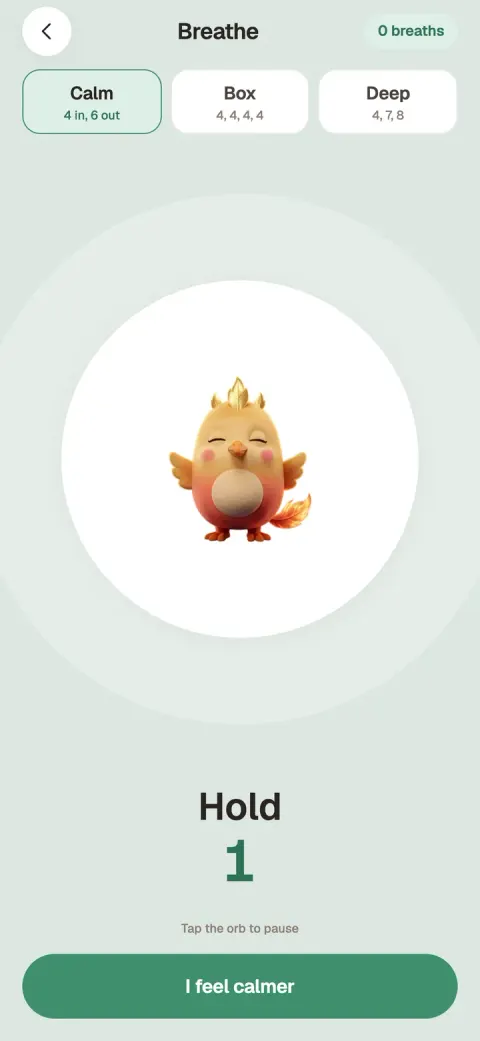
Slow, longer out-breaths calm the body's stress response, and a calmer body makes a calmer decision. Try breathing in for 4 seconds and out for 6, for two minutes. Box breathing (in 4, hold 4, out 4, hold 4) works for some people, and 4-7-8 for others.
4. Play the tape forward
Run the whole film, not just the first scene. If you drink tonight, what does 11 pm look like? Tomorrow morning? Then run the other version: you rode it out, and you wake up with the day you planned. Make the two versions specific, with your own costs.
5. Read your own reasons
Reasons written in your own words, in a calm moment, carry more weight than anything a friend or an app can say. Keep them where you will see them in seconds: your lock screen, your wallet, an app.
6. Make if-then plans before you need them
"If I walk past the off-licence after work, then I will take the other street." Plans in this form, called implementation intentions, have a strong research record: a 2006 meta-analysis of 94 studies found a medium to large effect on reaching goals compared with good intentions alone. Write one for each of your top three triggers.
7. Move
Short bouts of exercise reduce cigarette cravings in the moment, according to a systematic review in the journal Addiction. A brisk ten-minute walk is enough to try. It also gets you away from wherever the craving started.
8. Check HALT and reach a person
Hungry, angry, lonely, tired: the HALT check from mutual help groups is a quick way to spot what the craving is really about. Eat, vent, call someone, or rest. A two-minute call with someone who knows what you are doing is one of the strongest tools there is.
Match the tool to the trigger
| Trigger | First tool | Backup |
|---|---|---|
| Stress after work | Slow breathing, 2 minutes | Move: a walk before you go home |
| Boredom at night | Delay 15 minutes with a task | A calm game, a show, an early night |
| A party or social plan | If-then plan made in advance | Leave early; text your person |
| Loneliness | Call or message someone | Write it down; a community post |
| Payday or a win | Play the tape forward | Move the money to savings first |
| Seeing it online | Close the app, change the room | Urge surfing |
| Poor sleep | Rest first, decide later | Delay 15 minutes |
The same tools in one tap
We built the SOS screen in SoberChamp around these techniques, so that in the moment you do not have to remember any of them.
| SOS tool in SoberChamp | Technique | Time |
|---|---|---|
| 3-minute rescue | Breathe, name the urge, one small step | 3 minutes |
| Breathe | Calm 4-6, box 4-4-4-4 or 4-7-8 | As long as you need |
| Surf the urge | Urge surfing with a wave to ride | 90 seconds |
| Wait 15 min | Delay with small tasks to do meanwhile | 15 minutes |
| Ground me | 5-4-3-2-1 grounding | 1 to 2 minutes |
| Play it forward | Two paths, built from your own costs and gains | 1 minute |
| My reasons | Your why, your photos, notes from your past self | Seconds |
| Call your person, helplines | Reach a human; verified helplines for your country | Seconds |
When the craving passes, the app logs the win ("urge defeated"), and over time the insights page shows when your cravings come and which tools work best for you.
When a craving is more than a craving
If you feel unsafe, have thoughts of harming yourself, or are in withdrawal with shaking, confusion or seizures, this is not a craving to ride out. Call your local emergency number or a crisis line. For heavy daily drinkers, read the alcohol withdrawal timeline.
FAQ
How long does a craving last?
It varies by person and substance, but a single craving rises, peaks and falls rather than growing forever. Delaying for 15 minutes is usually long enough for the peak to pass, and cravings tend to get weaker and less frequent the longer you go without acting on them.
What is urge surfing?
A mindfulness technique where you observe a craving as physical sensations, rate it and watch it rise and fall, instead of fighting it or giving in. In a 2009 study, smokers taught it smoked fewer cigarettes over the next week.
How do you stop cravings at night?
Plan the evening in advance, because night cravings usually come from routine, tiredness and being alone. Use a delay timer, eat something, call someone, and go to bed earlier than usual for the first weeks.
Do cravings ever go away completely?
They become much rarer and weaker over time. An occasional mild craving can appear months or years later at an old trigger. Treat it as a memory, not a sign that something went wrong.
What if I give in to a craving?
Then you have one data point about what that trigger needs next time. Get back on plan the same day. Our page on what to do after a relapse walks through it.
Sources
- Bowen S, Marlatt A. Surfing the urge: brief mindfulness-based intervention for college student smokers. Psychology of Addictive Behaviors. 2009;23(4):666-71.
- Gollwitzer PM, Sheeran P. Implementation intentions and goal achievement: a meta-analysis of effects and processes. Advances in Experimental Social Psychology. 2006;38:69-119.
- Taylor AH, Ussher MH, Faulkner G. The acute effects of exercise on cigarette cravings, withdrawal symptoms, affect and smoking behaviour: a systematic review. Addiction. 2007;102(4):534-43.
- National Cancer Institute: Handling nicotine withdrawal and triggers.

Your sober clock, SOS and Sori in one app
SoberChamp tracks any habit, helps in one tap when a craving hits, and gives you Sori, an AI companion who answers in your language. The core tools are free.
Get notified at launchComing soon to iPhone and Android. One email on launch day, nothing else unless you ask.