What happens when you stop drinking: hour by hour, month by month
What changes in your body after your last drink, from the first hours to one year, with the research behind each step and the safety risks to know first.
Also in: DeutschEspañolFrançaisहिन्दीBahasa IndonesiaItaliano日本語한국어नेपालीPortuguês

Most timelines online make two mistakes. They promise the same thing to everyone, and they skip the part where stopping can be dangerous. This one does neither. What you notice depends on how much and how long you drank, your sleep, your diet and your health. The steps below describe what many people experience and what studies have measured, with the source next to each claim.
The timeline at a glance
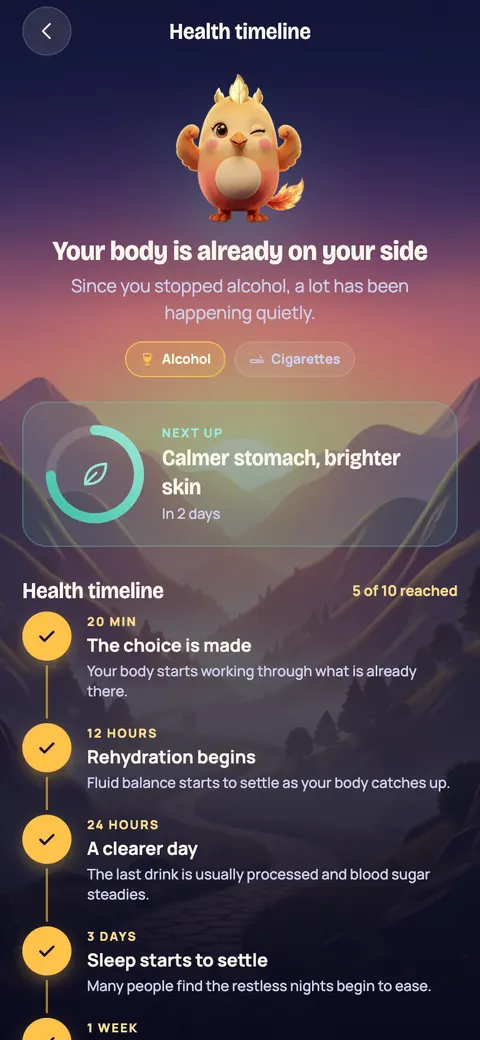
- HoursAlcohol leaves your bloodYour body clears alcohol at a roughly steady rate. Heavy daily drinkers may feel the first withdrawal signs within about 8 hours.
- 24 to 72 hThe hardest stretch, if you are dependentWithdrawal symptoms tend to peak in this window. People who drank lightly mostly feel tired and a bit restless.
- 3 to 7 daysSleep starts to settleAlcohol fragments the second half of the night. Without it, many people find nights less broken, though vivid dreams are common at first.
- 2 weeksCalmer stomach, steadier morningsLess acid and irritation, steadier blood sugar, fewer anxious mornings.
- 1 monthMeasurable changesIn one study, a month off alcohol lowered insulin resistance by about a quarter and systolic blood pressure by 6.6%.
- 3 monthsEnergy and moodMany people report steadier energy, clearer thinking and fewer low days. Mood problems that persist deserve a doctor's view.
- 1 yearLong-term risk fallsAlcohol causes at least seven types of cancer. The less you drink over time, the lower the risk.
General information, not a prediction for you. Sources at the end of the page.
The first day: alcohol leaves, withdrawal may begin
Your liver breaks down alcohol at a fairly fixed pace, so after a heavy night some alcohol is still in your blood the next morning. For people who drink lightly or occasionally, day one is mostly a hangover or nothing much at all.
For people who drink heavily every day, the brain has adapted to alcohol's sedating effect. Take it away and the nervous system runs hot. MedlinePlus, the US National Library of Medicine's health site, says withdrawal symptoms tend to occur within 8 hours of the last drink, can occur days later, and tend to peak by 24 to 72 hours. Symptoms include shakiness, sweating, anxiety, irritability, a fast heartbeat, nausea and trouble sleeping.
Days 2 to 3: the peak, and the warning signs
This is the window to take seriously. Delirium tremens, the most severe form of withdrawal, most often begins 48 to 96 hours after the last drink and can appear later. Seizures are most common in the first 12 to 48 hours.
Go to an emergency room or call your local emergency number if you notice seizures, high fever, severe confusion, hallucinations or an irregular heartbeat.
If you are not physically dependent, days two and three are when the habit pulls hardest: the usual time, the usual place, the usual reason. Cravings come in waves, and a wave passes faster when you ride it out instead of arguing with it. Our guide on how to stop cravings shows how.
The first week: sleep, mood and the evening gap
Alcohol helps you fall asleep and then breaks up the rest of the night. Researchers reviewing the evidence found that alcohol shortens the time to fall asleep and deepens early sleep, but disrupts the second half of the night. Without it, the first few nights can feel worse (vivid dreams, waking early) before they feel better.
The other thing you notice in week one is time. If you used to drink from 7 pm, there is now a gap of several hours that needs a plan: food, a walk, a call, a game, an early night. In SoberChamp you tell Sori your toughest hours when you set up, so the evening is the time the app checks in.
Weeks 2 to 4: the measurable month
In a 2018 study in BMJ Open, 94 moderate to heavy drinkers stopped drinking for a month and were compared with 47 who carried on. The group who stopped showed, on average:
| Measure | Change after one month without alcohol |
|---|---|
| Insulin resistance | down 25.9% |
| Systolic blood pressure | down 6.6% |
| Body weight | down 1.5% |
| VEGF (a growth factor linked to cancer) | down 41.8% |
| EGF (a growth factor linked to cancer) | down 73.9% |
The comparison group showed no significant change. The study was small and not randomised, so treat it as a strong hint, not a guarantee. It does match what many people report around day 30: better sleep, steadier weight, clearer skin.
94 people who stopped vs 47 who kept drinking. The control group showed no significant change.
Your liver also gets a break. The NHS says that at the early fatty liver stage, the liver can usually recover if you stop drinking.
Months 2 to 3: energy, money and a new routine
By now the gains are less about your body and more about your life: weekends that start on Saturday morning, conversations you remember, money that stays in your account. Here is what a month looks like with your own numbers.
What not drinking is worth to you
A week$196
A month$852
A year$10,227
Five years$51,135
Saved since your sober date:
Runs in your browser. Nothing you type is stored or sent.
If low mood, anxiety or poor sleep carries on for weeks, tell a doctor. Some people have symptoms that last for months after heavy drinking, and they are treatable.
One year: lower long-term risk
The World Health Organization notes that alcohol is a Group 1 carcinogen and causes at least seven types of cancer, including bowel and female breast cancer, and that risk starts with the first drink. Stopping or cutting down lowers your exposure from the day you start, and the benefit grows with time.
How to make the first month easier
- Talk to a doctor first if you drink every day or have had withdrawal before.
- Set your start time and watch it count. Our sobriety calculator shows your days, hours and next milestone.
- Plan the evenings for week one before day one starts.
- Have a craving plan you can use in two minutes: breathe, delay 15 minutes, read your reasons, call someone.
- Track something besides days: sleep, money, mood. Wins you can see are wins you keep.
- Pick an app that helps on bad nights: We compared the options in best apps to quit drinking.
FAQ
What happens to your body when you stop drinking?
In the first hours alcohol clears from your blood. If you were a heavy daily drinker, withdrawal can begin within about 8 hours and peak at 24 to 72 hours. Over the following weeks many people sleep better and feel steadier, and a one-month study found lower insulin resistance, blood pressure and weight on average.
How long after quitting alcohol do you feel better?
People who drank lightly often feel better within days. Heavy drinkers usually feel worse first, during withdrawal, then better over two to four weeks. Sleep and mood can take longer to settle fully.
Is it dangerous to stop drinking suddenly?
It can be, for people who drink heavily every day. Withdrawal can cause seizures and delirium tremens, which can be life-threatening. A doctor can make stopping safe, often with medication and monitoring.
Will I lose weight if I stop drinking?
Many people do, because drinks carry calories and drinking often brings late-night eating. In the BMJ Open study, people who stopped for a month lost 1.5% of their body weight on average.
Does your liver heal when you stop drinking?
The NHS says the liver can usually recover from the early fatty liver stage if you stop drinking. Later stages of liver disease may not fully reverse, which is one more reason to get checked.
Sources
- MedlinePlus: Alcohol withdrawal and Delirium tremens.
- Mehta G, et al. Short-term abstinence from alcohol and changes in cardiovascular risk factors, liver function tests and cancer-related growth factors. BMJ Open. 2018;8(5):e020673.
- Ebrahim IO, et al. Alcohol and sleep I: effects on normal sleep. Alcoholism: Clinical and Experimental Research. 2013.
- NHS: Alcohol-related liver disease.
- WHO Europe: No level of alcohol consumption is safe for our health, 2023.

Your sober clock, SOS and Sori in one app
SoberChamp tracks any habit, helps in one tap when a craving hits, and gives you Sori, an AI companion who answers in your language. The core tools are free.
Get notified at launchComing soon to iPhone and Android. One email on launch day, nothing else unless you ask.