
Milestones work because recovery is long and days are short. "Forever" is too big to hold; "today" and "the next marker" are the right size. They also give the people around you a reason to say well done, which matters more than most of us admit. Here is what the common markers tend to bring, where the risky stretches are, and how to celebrate without a drink in your hand.
Count your days
Not sure where you are? The sobriety calculator shows your days, hours, weeks and next milestone from your sober date.
The milestones, one by one
- 24 hoursOne full dayProof it can be done. For heavy drinkers, also the start of the window where withdrawal needs watching.
- 3 daysThrough the first peakFor alcohol and nicotine, withdrawal often peaks in the first 72 hours.
- 1 weekA full week, including a weekendEvery day of the week has been faced once without it.
- 30 daysOne monthSleep and routine usually feel different. One study found lower blood pressure and insulin resistance after a month without alcohol.
- 60 daysTwo monthsThe motivation of the start fades. Habits and support carry you now.
- 90 daysThree monthsA long-standing marker in mutual help groups and treatment programs.
- 6 monthsHalf a yearMany seasons, events and stresses have been met sober.
- 1 yearThe first anniversaryA full cycle of birthdays, holidays and hard dates.
24 hours
The first full day is the hardest proof and the most important one. If you drink heavily every day, it is also when withdrawal can begin, so have a doctor's plan. See the alcohol withdrawal timeline.
3 days
For alcohol, withdrawal symptoms tend to peak at 24 to 72 hours. For nicotine, the National Cancer Institute says symptoms are usually worst in the first three days. Reaching day three often means the physical peak is behind you.
1 week
Seven days means one of every weekday: one Monday after work, one Friday night, one Sunday. Most triggers have shown up once, and you have met them.
30 days
The month is when people start to notice gains they did not expect: better sleep, steadier mornings, money left at the end of the month. A study in BMJ Open found that a month without alcohol lowered insulin resistance by about a quarter and systolic blood pressure by 6.6% on average.
60 days
This is the quiet danger zone. The early high fades, life gets busy, and "I've got this" turns into "one won't hurt". It is the time to double down on routines and people, not to relax them.
90 days
Ninety days is a long-standing marker in mutual help groups and treatment programs. It is long enough for new routines to feel like your own. It is also not a finish line. NIDA puts relapse rates for substance use disorders at 40 to 60 percent, the same as for other chronic conditions such as hypertension and asthma.
Bars show the top of each range. Source: NIDA, Drugs, Brains, and Behavior: The Science of Addiction.
6 months
Half a year means you have been sober through a change of season, probably an illness, a celebration and a bad week. Your sense of who you are has started to shift.
1 year
The first year holds every anniversary once: your birthday, the holidays, the date something hard happened. Getting through each one sober is why the one-year mark carries so much weight.
Chips, coins and other ways to mark it
Many groups give chips or coins for time milestones, often at 24 hours, 30, 60 and 90 days, then at months and years. You do not need a group to do something similar.
| Milestone | Ways to mark it without a drink |
|---|---|
| 1 week | A meal you love; tell one person |
| 30 days | Buy something with part of what you saved |
| 90 days | A day trip; write a letter to your day-one self |
| 6 months | Plan something you could not have done before |
| 1 year | A real celebration with the people who helped; give something back |
How SoberChamp marks milestones
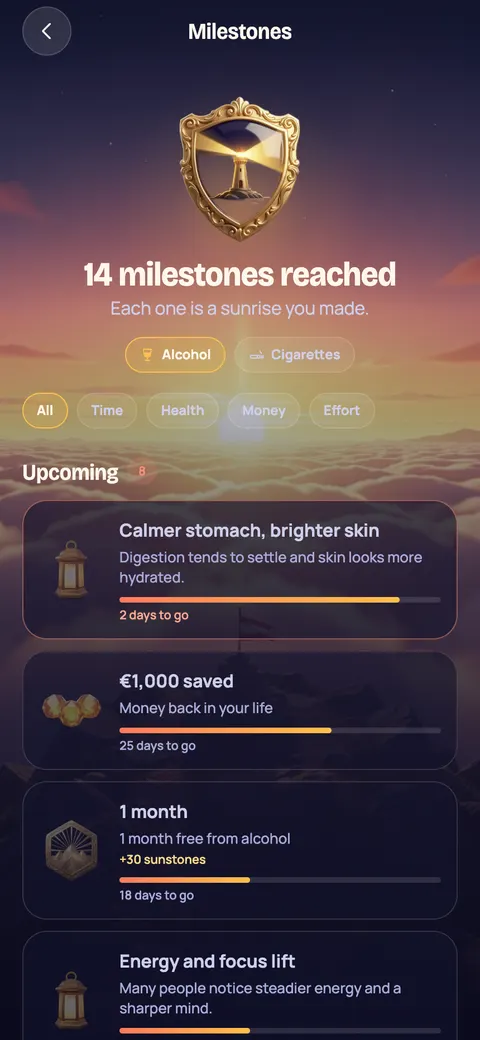
SoberChamp celebrates time milestones from the first hour through 24 hours, 3 days, 1 and 2 weeks, 1 month, 60 and 90 days, 6 months and 1 year. It also tracks health milestones for each habit, money milestones in your own currency (from 25 up to 10,000), and effort milestones. Each has a shareable card where you choose which numbers to show.
Your rank grows with showing up, through nine ranks from Spark to Legend, so it does not depend on an unbroken streak.
If a milestone slips away
Missing a milestone you were close to is hard. It does not undo the days you had. In SoberChamp a slip opens Rise Again: you note what happened, your current run restarts, and your lifetime sober days, best run and rank stay. Our guide on what to do after a relapse walks through the next 24 hours.
FAQ
What are the main sobriety milestones?
The most common are 24 hours, 3 days, 1 week, 30 days, 60 days, 90 days, 6 months and 1 year, then every year after that.
Why is 90 days sober important?
Ninety days is a long-standing marker in mutual help groups and treatment programs. By then new routines have usually taken hold, and many people say their thinking feels clearer.
What happens at 30 days sober?
Many people notice better sleep, steadier mood and more money. A one-month study of people who stopped drinking found lower insulin resistance, blood pressure and weight on average.
How should I celebrate a sobriety milestone?
Choose something that fits the new life: a meal, a trip, a purchase from the money you saved, or time with people who supported you. Share it with at least one person.
What is the hardest stretch of early sobriety?
The first three days are often the hardest physically. Many people find the second and third months hard in a different way, when the early motivation fades.
Sources
- MedlinePlus: Alcohol withdrawal.
- National Cancer Institute: Handling nicotine withdrawal and triggers.
- Mehta G, et al. Short-term abstinence from alcohol. BMJ Open. 2018.
- NIDA: Treatment and recovery.

Your sober clock, SOS and Sori in one app
SoberChamp tracks any habit, helps in one tap when a craving hits, and gives you Sori, an AI companion who answers in your language. The core tools are free.
Get notified at launchComing soon to iPhone and Android. One email on launch day, nothing else unless you ask.