
Gambling is the habit that does the most damage in the least time, because the thing you lose is money and money touches everything. It is also the habit with the most tools for putting a wall between you and the next bet. The plan below starts with those walls, because when an urge hits on payday at 11 pm, a wall works better than a good intention.
You are not the only one
The US National Council on Problem Gambling estimates that about 2.5 million US adults (around 1%) meet the criteria for a severe gambling problem in a given year, and another 5 to 8 million (2 to 3%) have mild or moderate problems. Gambling disorder is a recognised condition in the DSM-5, listed alongside substance use disorders.
National Council on Problem Gambling. The second bar shows the top of the 5 to 8 million range.
Step 1: Block access today
Do these in the next hour, while you are motivated.
| Wall | What it does | Cost |
|---|---|---|
| Self-exclusion from operators | Bars you from gambling sites and venues for a set period | Free |
| GAMSTOP (UK) | One sign-up excludes you from all UK-licensed online gambling sites and apps | Free |
| State self-exclusion programs (US) | Many states with legal gambling run programs for casinos and online betting | Free |
| Bank gambling block | Many banks and card providers let you block gambling transactions in their app | Free |
| Blocking software | Blocks gambling sites and apps on your devices (BetBlocker is free; others are paid) | Free to paid |
| Delete apps and accounts | Close every betting account and remove saved cards | Free |
Step 2: Protect your money
- Hand over control for a while: Ask a trusted person to hold your cards, or set up a second signature for large withdrawals.
- Make payday boring: Move bills and savings out the moment your pay lands.
- Stop chasing: Chasing losses is the engine of gambling harm. The money already lost is gone; the next bet does not bring it back, it only adds to the hole.
- Get debt advice: Free, confidential debt advice exists in most countries. A plan for the debt removes one of the biggest triggers.
See what gambling has been costing you over time:
What stopping gambling keeps in your pocket
A week$210
A month$913
A year$10,958
Five years$54,788
Saved since your sober date:
Runs in your browser. Nothing you type is stored or sent.
For the calculator, enter your average net loss on a gambling day and how many days a week you gamble divided by seven (for example 3 days a week = 0.43).
Step 3: Handle the urge
Gambling urges follow the same wave as other cravings: they rise, peak and pass.
- Delay 15 minutes: No decision until the timer ends.
- Play it forward: Not the win you imagine, the realistic night: the deposit, the chase, the 3 am feeling.
- Change the scene: Leave the room, put the phone in another room, go outside.
- Call someone: Your person, a helpline, a group.
- Know your triggers: Payday, live sport, boredom, loneliness, a win, a loss, drink. Write an if-then plan for each.
More techniques are in how to stop cravings.
Step 4: Replace what gambling gave you
Gambling usually does a job: excitement, escape from worry, something to share with friends, the hope of fixing money problems. If you do not replace that job, the urge comes back. Sport you play instead of bet on, a hobby with stakes that are not money, time with people who do not gamble, and a savings goal you can watch grow all do part of it.
Step 5: Get support
Cognitive behavioural therapy (CBT) has the strongest evidence among talking therapies for problem gambling. A Cochrane review found it reduced gambling behaviour in the short term. Peer groups such as Gamblers Anonymous help many people, and family members can get support too.
| Where you are | Free help |
|---|---|
| United States | National Problem Gambling Helpline: call or text 1-800-MY-RESET (1-800-697-3738), or chat at 1800myreset.org |
| United Kingdom | National Gambling Helpline (GamCare): 0808 8020 133, 24 hours, every day |
| Anywhere | Gamblers Anonymous meetings; findahelpline.com |
How SoberChamp helps
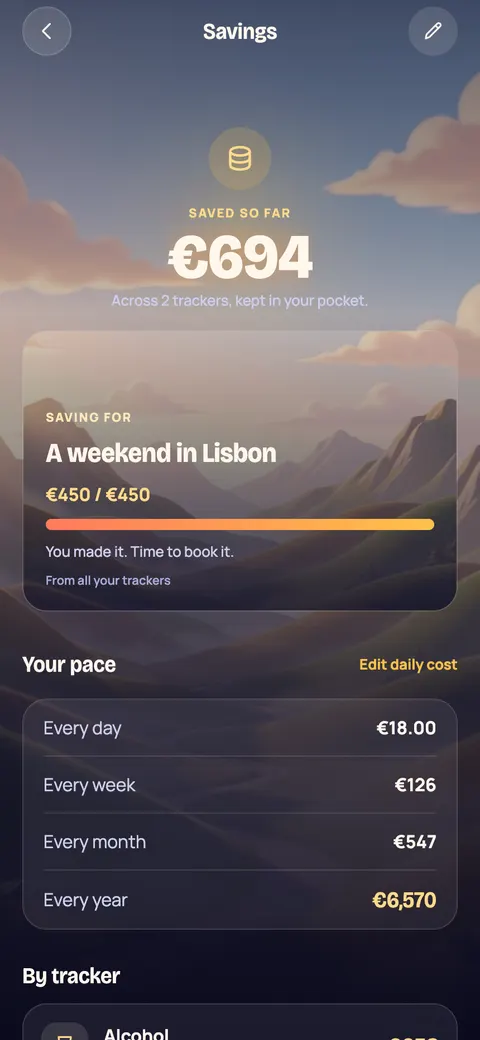
SoberChamp tracks gambling as its own habit with a live clock and the money you keep, in your own currency, with a savings goal you choose. Payday and late nights are when urges hit, so you can tell Sori your tough times and use SOS (delay timer, play it forward, call your person, helplines for your country) in one tap. If you slip, Rise Again keeps your lifetime days and best run.
FAQ
How do I stop gambling right now?
Block access first: self-exclude, install blocking software, turn on your bank's gambling block and delete betting apps. Then tell one person and call a helpline. Walls work better than willpower in the moment.
How do I stop chasing losses?
Accept that money already lost is gone, set a rule that you never bet to win it back, and remove the means to do it, such as saved cards and accounts. Free debt advice helps take the pressure off.
Is there a helpline for gambling?
In the US, call or text 1-800-MY-RESET (1-800-697-3738). In the UK, call the National Gambling Helpline on 0808 8020 133, open 24 hours. For other countries, see findahelpline.com.
What is GAMSTOP?
A free UK service that lets you exclude yourself from all online gambling sites and apps licensed in Great Britain for six months, one year or five years.
What therapy works for gambling addiction?
Cognitive behavioural therapy has the most evidence. Peer support groups and support for family members also help many people.
Sources
- National Council on Problem Gambling: FAQ (helpline and prevalence).
- GamCare: National Gambling Helpline.
- GAMSTOP: gamstop.co.uk.
- Cowlishaw S, et al. Psychological therapies for pathological and problem gambling. Cochrane Database of Systematic Reviews. 2012;(11):CD008937.
- American Psychiatric Association. DSM-5. Gambling disorder.

Your sober clock, SOS and Sori in one app
SoberChamp tracks any habit, helps in one tap when a craving hits, and gives you Sori, an AI companion who answers in your language. The core tools are free.
Get notified at launchComing soon to iPhone and Android. One email on launch day, nothing else unless you ask.