
Your body starts to recover within minutes of your last cigarette, and your wallet starts the same day. Below is the recovery timeline published by the US Centers for Disease Control and Prevention (CDC), a calculator for the money side, and what to expect from nicotine withdrawal in the first weeks.
How much money will you save?
Enter what you smoke and what you pay. Add your quit date to see what you have already kept.
Quit smoking savings calculator
A week$63.00
A month$274
A year$3,287
Five years$16,436
Saved since your sober date:
Runs in your browser. Nothing you type is stored or sent.
- Saved
See the data
| Time smoke free | Saved |
|---|---|
| Month 1 | $274 |
| Month 6 | $1,644 |
| Year 1 | $3,287 |
| Year 2 | $6,575 |
| Year 5 | $16,436 |
| Year 10 | $32,873 |
Example only, before any price rises or interest. Use your own numbers in the calculator above.
At a pack a day and $9 a pack, that is $63 a week, about $274 a month and about $3,287 a year. Over ten years, the money alone would buy a decent used car, before counting any price rises.
The health timeline
These are the CDC's own milestones, measured against continuing to smoke.
- MinutesHeart rate drops
- 24 hoursNicotine level in the blood drops to zero
- Several daysCarbon monoxide in the blood falls to the level of a non-smoker
- 1 to 12 monthsCoughing and shortness of breath decrease
- 1 to 2 yearsRisk of heart attack drops sharply
- 3 to 6 yearsAdded risk of coronary heart disease drops by half
- 5 to 10 yearsAdded risk of mouth, throat and voice box cancers drops by half; stroke risk decreases
- 10 to 15 yearsAdded risk of lung cancer drops by half
- 15 yearsRisk of coronary heart disease close to that of a non-smoker
- 20 yearsRisk of mouth, throat and voice box cancers close to that of a non-smoker
Source: CDC, Benefits of Quitting. The CDC also says quitting can add as much as 10 years to life expectancy.
The early steps matter for motivation. The later ones are why quitting at any age is worth it. The CDC says quitting smoking can add as much as 10 years to life expectancy, and that the risk of coronary heart disease falls sharply within one to two years.
Nicotine withdrawal: the first weeks
According to the US National Cancer Institute, withdrawal symptoms are usually worst in the first week, peaking during the first three days, and then ease over the first month. Cravings can start within an hour or two of the last cigarette.
| Symptom | What to expect | What helps |
|---|---|---|
| Cravings | Frequent in the first days and weeks, then less often; an occasional mild one can show up months later | Delay 15 minutes, breathe, change place, drink water |
| Irritability and anger | Peaks within the first week, may last 2 to 4 weeks | Tell people you are quitting; exercise; slow breathing |
| Low mood | Usually lifts within a month | Daylight, movement, talk to someone; see a doctor if it persists |
| Trouble sleeping | Common early on | Cut caffeine after midday; a fixed bedtime |
| Hunger | Common; weight gain is usually under 10 pounds | Plan snacks, keep moving |
| Poor concentration | A few weeks | Short tasks, lists, breaks |
Stop smoking medicines (nicotine patches, gum and lozenges, and prescription medicines) make withdrawal easier and raise the chance of success. A doctor or pharmacist can tell you which suits you.
Getting through the first three days
- Set the date and the plan: Know what you will do at your usual smoke times: after meals, with coffee, on breaks, in the car.
- Clear the triggers: Cigarettes, lighters and ashtrays go. Wash the jacket that smells of smoke.
- Ride the cravings: A craving rises, peaks and falls. Our guide to stopping cravings shows the wave and five ways to ride it.
- Use free help: In the US call 1-800-QUIT-NOW (1-800-784-8669) for free coaching. In England, local NHS Stop Smoking Services offer free support.
- Count the wins: Days, money and the next health milestone.
If you smoke and drink
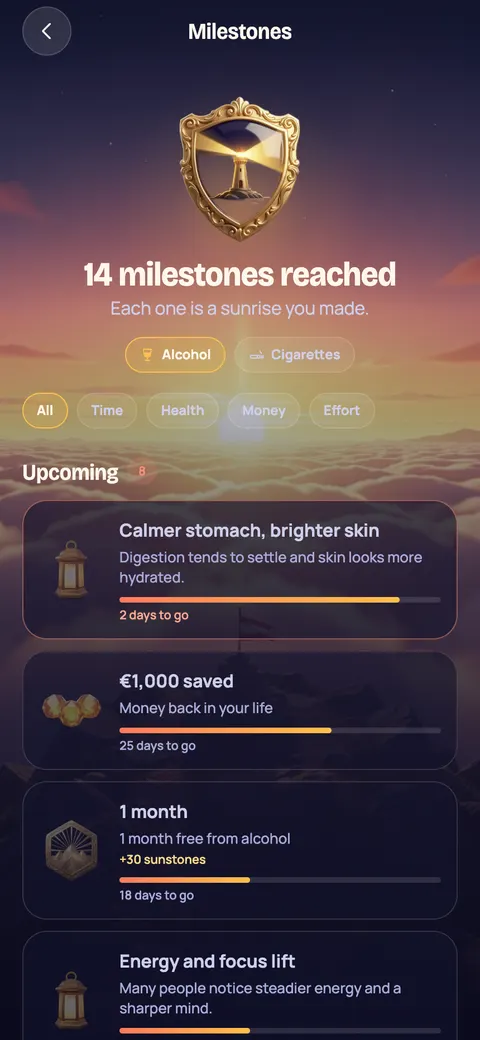
Alcohol and cigarettes often travel together, and one can trigger the other. SoberChamp lets you track both at once with separate clocks, savings and health timelines, and set a different goal for each: quit cigarettes now, cut down on drinking first, or the other way round.
Switching to vaping? Nicotine is still nicotine. Our quit vaping timeline covers what is different.
FAQ
What happens to your body when you quit smoking?
Within minutes your heart rate drops. Within 24 hours nicotine in your blood falls to zero, and within several days carbon monoxide falls to a non-smoker's level. Coughing and breathlessness ease over months, heart attack risk drops sharply within one to two years, and cancer risks keep falling for decades.
How long does nicotine withdrawal last?
It is usually worst in the first week, peaking in the first three days, and eases over about a month. Some people have symptoms for longer, and occasional cravings can return months later.
How much money will I save if I quit smoking?
Multiply what you spend a day by 365. At one pack a day and $9 a pack that is about $3,287 a year, or about $32,873 over ten years. Use the calculator above with your own numbers.
Is it ever too late to quit smoking?
No. The CDC lists benefits at every stage, from minutes to 20 years after quitting, and says quitting can add as much as 10 years to life expectancy.
What is the best app to quit smoking?
Smoke Free and QuitSure are built only for cigarettes. SoberChamp tracks cigarettes alongside any other habit, with a health timeline, savings and SOS for cravings. See our comparison of sobriety apps.
Sources
- CDC: Benefits of quitting smoking.
- National Cancer Institute: Handling nicotine withdrawal and triggers when you decide to quit tobacco.
- Smokefree.gov (NCI): Understanding withdrawal.
- CDC: 1-800-QUIT-NOW quitline.

Your sober clock, SOS and Sori in one app
SoberChamp tracks any habit, helps in one tap when a craving hits, and gives you Sori, an AI companion who answers in your language. The core tools are free.
Get notified at launchComing soon to iPhone and Android. One email on launch day, nothing else unless you ask.