
"Weed isn't addictive, so quitting is easy" is a line many daily users believe until night three, when they are wide awake at 4 am, irritable and craving. Cannabis withdrawal is real, it is common in regular users, and it is in the psychiatric manuals. The good news: it is usually short, it is not dangerous on its own, and the worst of it is predictable, which means you can plan for it.
How common is cannabis withdrawal?
A 2020 meta-analysis in JAMA Network Open pooled 47 studies with 23,518 people who used cannabis regularly or had cannabis use disorder. Overall, 47% experienced cannabis withdrawal syndrome. The rate was much higher in clinical settings, and higher with daily use and with tobacco use alongside cannabis.
Bahji et al., JAMA Network Open, 2020. 47 studies, 23,518 participants.
The timeline
- Day 1 to 3Symptoms startMost symptoms begin within 24 to 72 hours: irritability, anxiety, restlessness, poor appetite, trouble sleeping.
- First weekThe peakSymptoms usually peak within the first week. Sleep is often the hardest part, with vivid or strange dreams.
- 1 to 2 weeksMost symptoms easeFor most people the main symptoms last about one to two weeks.
- Up to a month or moreSleep settles lastSleep difficulties can last more than 30 days for some people.
Timing as described in the DSM-5-TR and the clinical literature. Heavier, longer use tends to mean stronger symptoms.
Symptoms to expect
The DSM-5-TR describes cannabis withdrawal as three or more of these within about a week of stopping heavy, prolonged use:
| Symptom | What it feels like | What helps |
|---|---|---|
| Irritability, anger | Short fuse, small things feel big | Warn people close to you; exercise |
| Nervousness, anxiety | On edge, restless thoughts | Slow breathing, grounding, daylight |
| Sleep difficulty | Insomnia, vivid or disturbing dreams | Fixed wake time, no screens in bed, no caffeine after midday |
| Decreased appetite | Not hungry, some weight loss | Small regular meals, easy food |
| Restlessness | Cannot sit still | Walks, chores, anything with your hands |
| Depressed mood | Flat, low | Contact with people; a doctor if it lasts |
| Physical discomfort | Stomach pain, shakiness, sweating, chills, headache | Rest, fluids; see a doctor if severe |
On its own, cannabis withdrawal is not dangerous the way alcohol or benzodiazepine withdrawal can be. If you are also stopping alcohol or sedatives, or you take medication, talk to a doctor first.
A plan for the first two weeks
- Clear your stash and the kit: Grinders, papers, vapes, the number of the person you buy from.
- Protect your sleep: Expect three to seven rough nights. Same wake time every day, exercise early, a wind-down that does not involve a screen. If sleep is still bad after a few weeks, talk to a doctor.
- Replace the ritual: If you smoked to end the day, you need a new way to end the day: a shower, a walk, a show, a call.
- Plan your social exposure: Friends who smoke, certain places, certain music. Decide in advance where you will be on the first weekend.
- Ride the cravings: They peak and pass. See how to stop cravings.
- Watch tobacco: Many people mix cannabis with tobacco. Stopping both at once is hard but avoids one triggering the other; if you vape nicotine, read the quit vaping timeline too.
How SoberChamp helps with cannabis
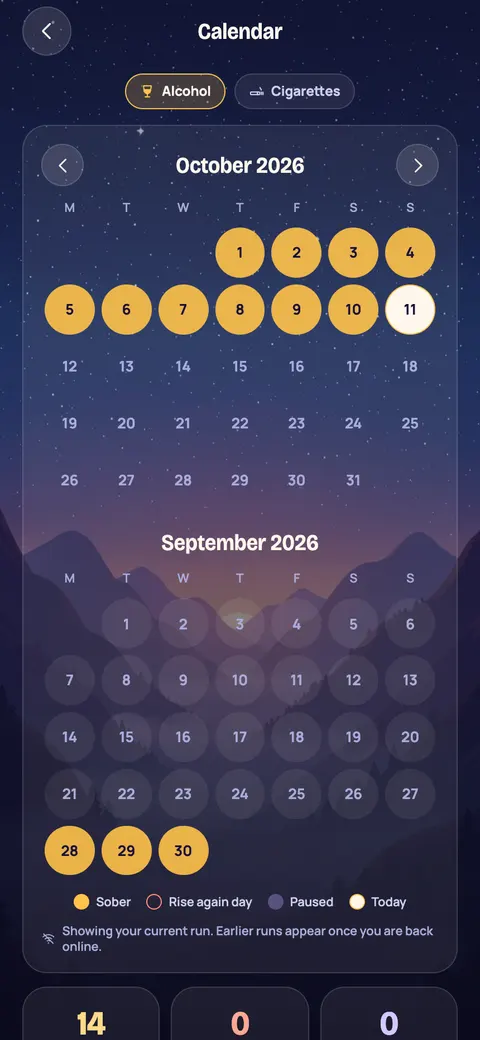
SoberChamp tracks cannabis as its own habit with a live clock, money saved and a calendar. You can quit, cut down with a daily limit, or taper week by week. When a craving hits at night, SOS has breathing, urge surfing and a 15-minute delay, and Sori is there to talk to when everyone else is asleep. The Haven has sleep sounds and calm games for restless evenings.
Help
In the US, SAMHSA's National Helpline is free, confidential and open 24 hours: 1-800-662-4357. In the UK, talk to your GP or FRANK on 0300 123 6600.
FAQ
How long does weed withdrawal last?
Most symptoms start within 24 to 72 hours, peak within the first week and ease over one to two weeks. Sleep problems can last longer, sometimes more than a month.
What are the worst days of cannabis withdrawal?
Usually somewhere in the first week, when irritability, anxiety and poor sleep peak.
Is cannabis withdrawal dangerous?
On its own it is uncomfortable rather than dangerous. Talk to a doctor if you are also stopping alcohol or sedatives, have a mental health condition, or have severe symptoms.
Why can't I sleep after quitting weed?
Sleep disruption is one of the most common cannabis withdrawal symptoms and often the last to settle, including vivid dreams. A fixed wake time, daytime exercise and no screens in bed help most people within a few weeks.
Does everyone get withdrawal when they quit weed?
No. In a large meta-analysis, about 47% of regular users had withdrawal syndrome. It was more likely with daily use, heavier use and tobacco use alongside cannabis.
Sources
- Bahji A, et al. Prevalence of cannabis withdrawal symptoms among people with regular or dependent use of cannabinoids. JAMA Network Open. 2020;3(4):e202370.
- American Psychiatric Association. Diagnostic and Statistical Manual of Mental Disorders, Fifth Edition, Text Revision (DSM-5-TR). 2022. Cannabis withdrawal.
- Budney AJ, et al. Review of the validity and significance of cannabis withdrawal syndrome. American Journal of Psychiatry. 2004;161(11):1967-77.
- SAMHSA: National Helpline. FRANK: talktofrank.com.

Your sober clock, SOS and Sori in one app
SoberChamp tracks any habit, helps in one tap when a craving hits, and gives you Sori, an AI companion who answers in your language. The core tools are free.
Get notified at launchComing soon to iPhone and Android. One email on launch day, nothing else unless you ask.